Software product · Ongoing
HoundStack
Start with the route, then design the business around it.
Specialized operations software for pet waste removal companies, built by working outward from the one thing the whole business depends on: the route.
- Organization
- HoundStack
- Industry
- Field-service software for pet waste removal companies
- My role
- Product Owner
- Status
- Pre-launch, early access
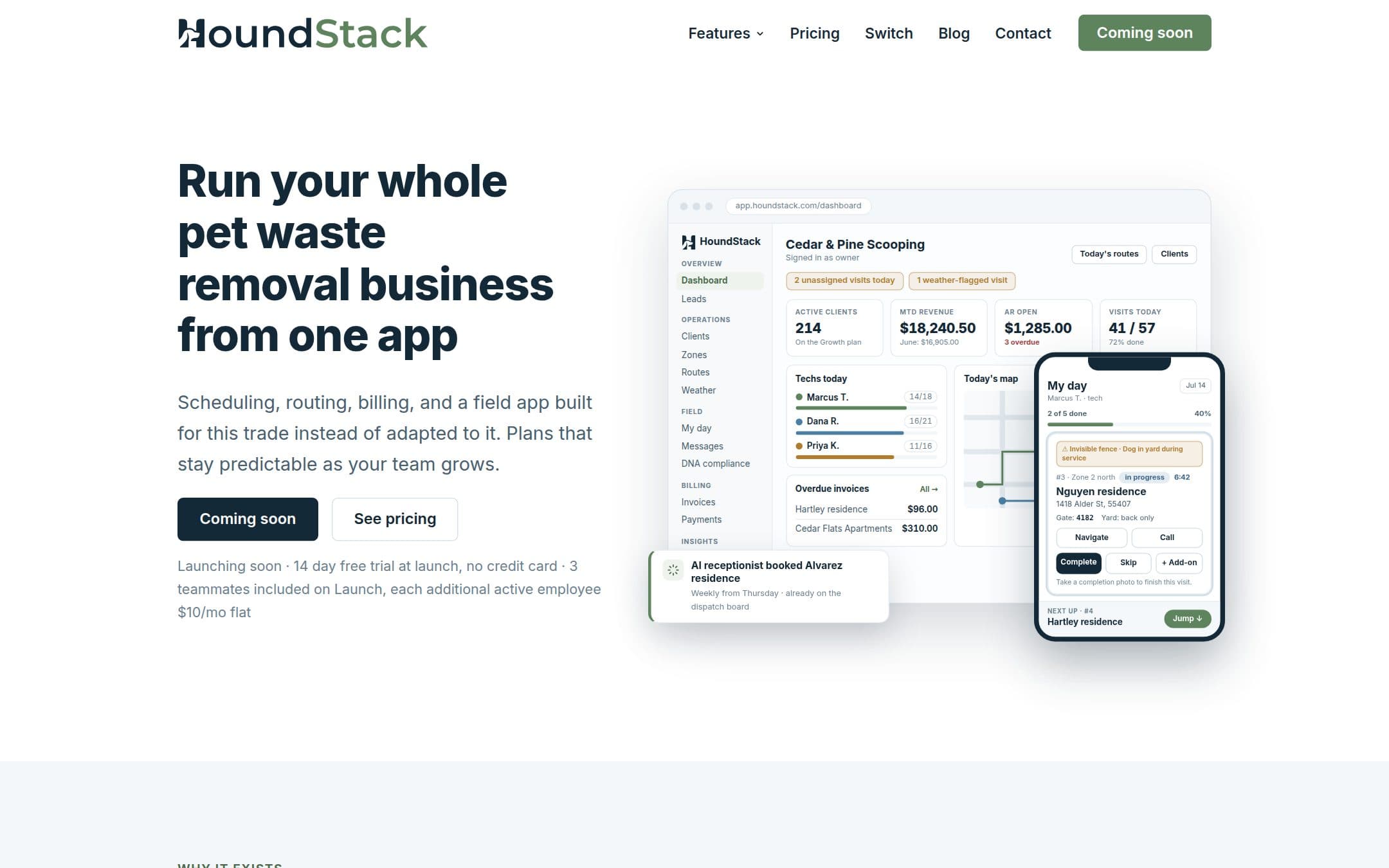
A working demonstration
The route is the atomic unit of this business. Here it is, sequencing.
Go on, move something.
Try it
Sequence a morning route
Add a stop anywhere in the service zone, then sequence it. This is a real nearest-neighbour pass with a 2-opt cleanup, the same shape of problem the product solves every morning. Illustrative stops only.
- Stops
- 8
- Dogs on route
- 16
- Estimated time
- 187min
- Order
- As entered
Multiply that saving by five technicians, six days a week, and it stops being a routing detail and becomes the margin. That is why the product model starts at the route rather than at the invoice.
Situation
Before anything was designed.Where this started
Pet waste removal looks simple from the outside. A technician visits a yard on a schedule and cleans it. The operational reality is anything but.
Pricing depends on how many dogs live at the property and how often the service runs. Routes have to be efficient enough to make a low-ticket service profitable. Weather cancels days and pushes work forward. Commercial properties and HOAs have entirely different requirements than a single-family yard, including per-unit tracking and DNA compliance programs. Technicians work in back yards where the signal drops.
Operators were running this on generic field-service software that was designed for trades with high-value, low-frequency jobs. Every one of them had a spreadsheet, a group chat, or a whiteboard filling the gap.
The core challenge
The problem to solve
Translate a deeply specific operational industry into a product, without building a generic scheduling tool with a dog on the logo.
Who it had to work for
The people on the other side of it
- Owner-operators
- One system that runs the business so they can be in the field instead of in the office.
- Office staff
- Scheduling, billing, and customer communication that does not require re-entering the same information three times.
- Field technicians
- A route view that works in a back yard with poor signal and takes seconds, not minutes.
- Commercial and HOA clients
- Per-unit tracking, compliance records, and reporting they can hand to a property board.
My responsibilities
First person, on purpose.What I was responsible for
Stated by specific verb, so it is clear what I did rather than what the project did.
- DefinedProduct vision and the principles the product is judged against.
- LedIndustry research and competitive analysis across generic and specialized field-service tools.
- DesignedWorkflow architecture for scheduling, routing, dispatch, and the field technician experience.
- DefinedRequirements, acceptance criteria, and edge cases for each feature area.
- ManagedFeature prioritization against operator impact rather than build convenience.
- DefinedPricing strategy, including per-dog and service-frequency models.
- DesignedThe client lifecycle: onboarding, active service, pause, cancellation, and win-back.
- DefinedBilling logic, including recurring billing against variable service delivery.
- DefinedRole-based access for owners, office staff, technicians, and franchise operators.
- LedQuality assurance and regression review across releases.
- BuiltProduct documentation and the specifications engineering works from.
Strategic approach
How I approached it
The route is the atomic unit
Most field-service software starts with the job. In this industry the route is the thing that determines whether the business is profitable, so the product model starts there and works outward to scheduling, billing, and customer management.
Design for the worst environment, not the demo
The technician workflow was specified for a back yard with one bar of signal and a phone in one hand. Offline capability was treated as a core requirement, not a later enhancement.
Make the edge cases explicit
Weather rescheduling, a customer adding a third dog mid-cycle, an HOA unit changing hands, a skipped visit that should not be billed. These were written into requirements as first-class flows rather than discovered in production.
Growth features belong to operations
Referrals, review requests, and neighborhood density are growth mechanics, but they are driven by route data. Building them inside the operational model rather than bolting on a marketing module keeps them accurate.
The journey
The path it had to support
- Lead and quoteProspect enters with an address, dog count, and desired frequency. Pricing resolves from those three inputs.
- OnboardProperty details, access notes, gate codes, and service zone assignment captured once.
- ScheduleRecurring visits generated from frequency, then placed into route sequence by zone.
- DispatchDaily routes assigned to technicians, with capacity and drive time accounted for.
- ServiceTechnician completes the visit in the field, offline-tolerant, with proof of service captured.
- BillRecurring billing reconciles against what was actually delivered, including skips and weather moves.
- Retain and growReview requests, referrals, and neighbor targeting driven by completed route data.
Diagram
Why pricing, scheduling, and billing cannot be separate modules
A change in dog count or frequency has to propagate through pricing, the recurring schedule, the route, and the invoice. Modeling these as independent systems is where generic tools break.
- Dog count
- Service frequency
- Price model
- Recurring schedule
- Route sequence
- Delivered service
- Invoice
What was built
Designed, specified, and shipped
- Product vision and positioning for a specialized vertical
- Workflow architecture across customer management, scheduling, routing, and dispatch
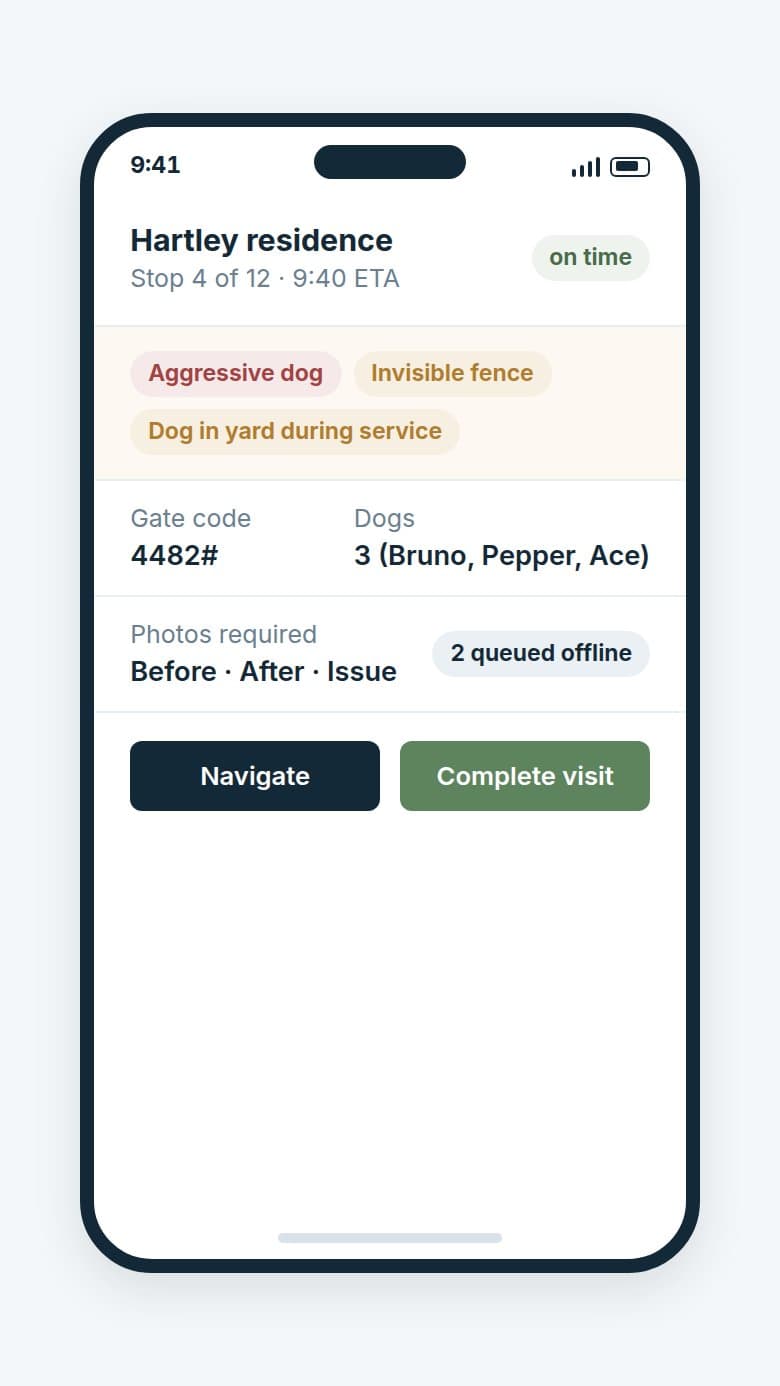
- Offline-tolerant field technician workflow specification
- Per-dog and service-frequency pricing model
- Billing logic reconciling recurring charges against delivered service
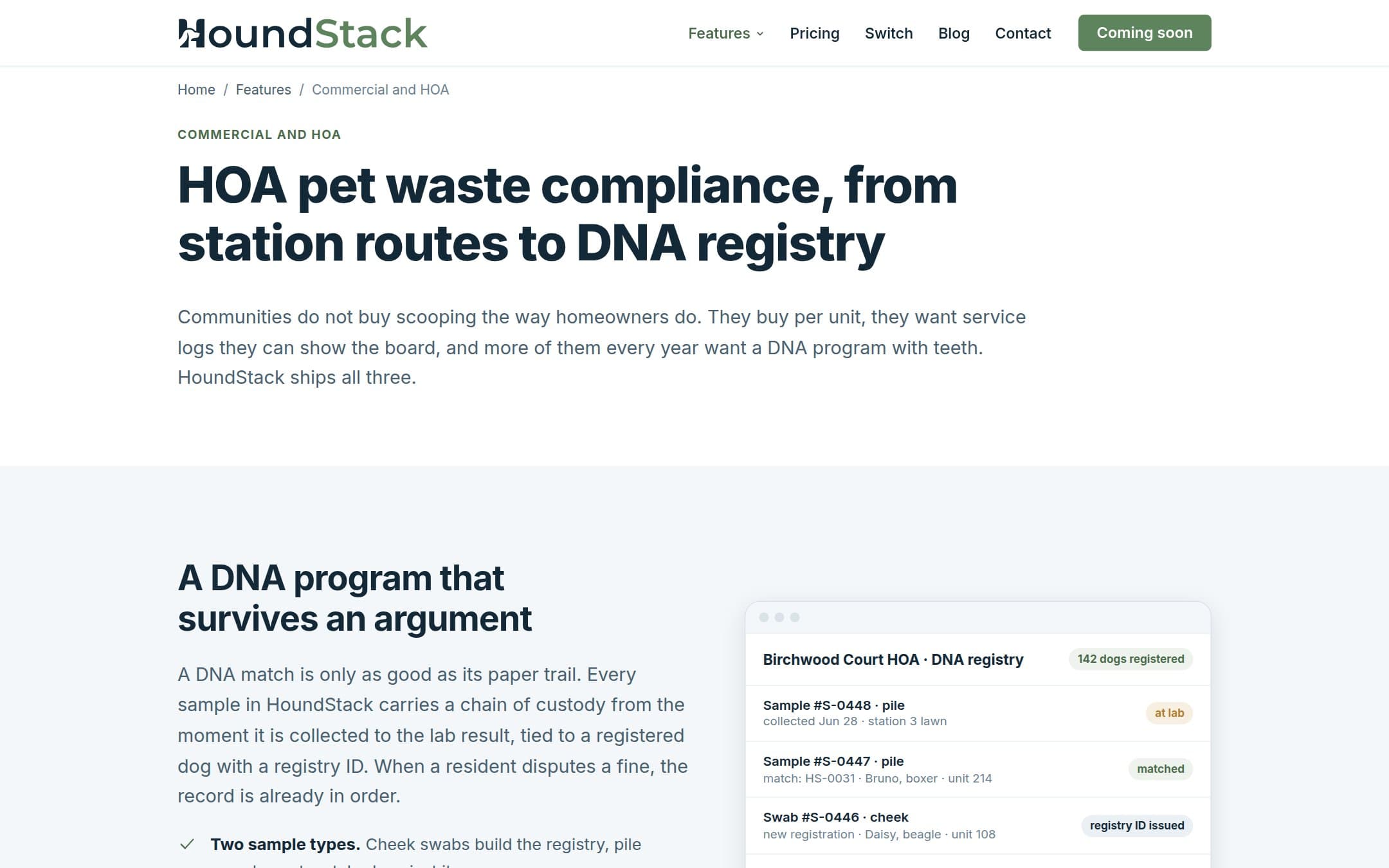
- Commercial and HOA operations, including property-unit workflows and DNA compliance
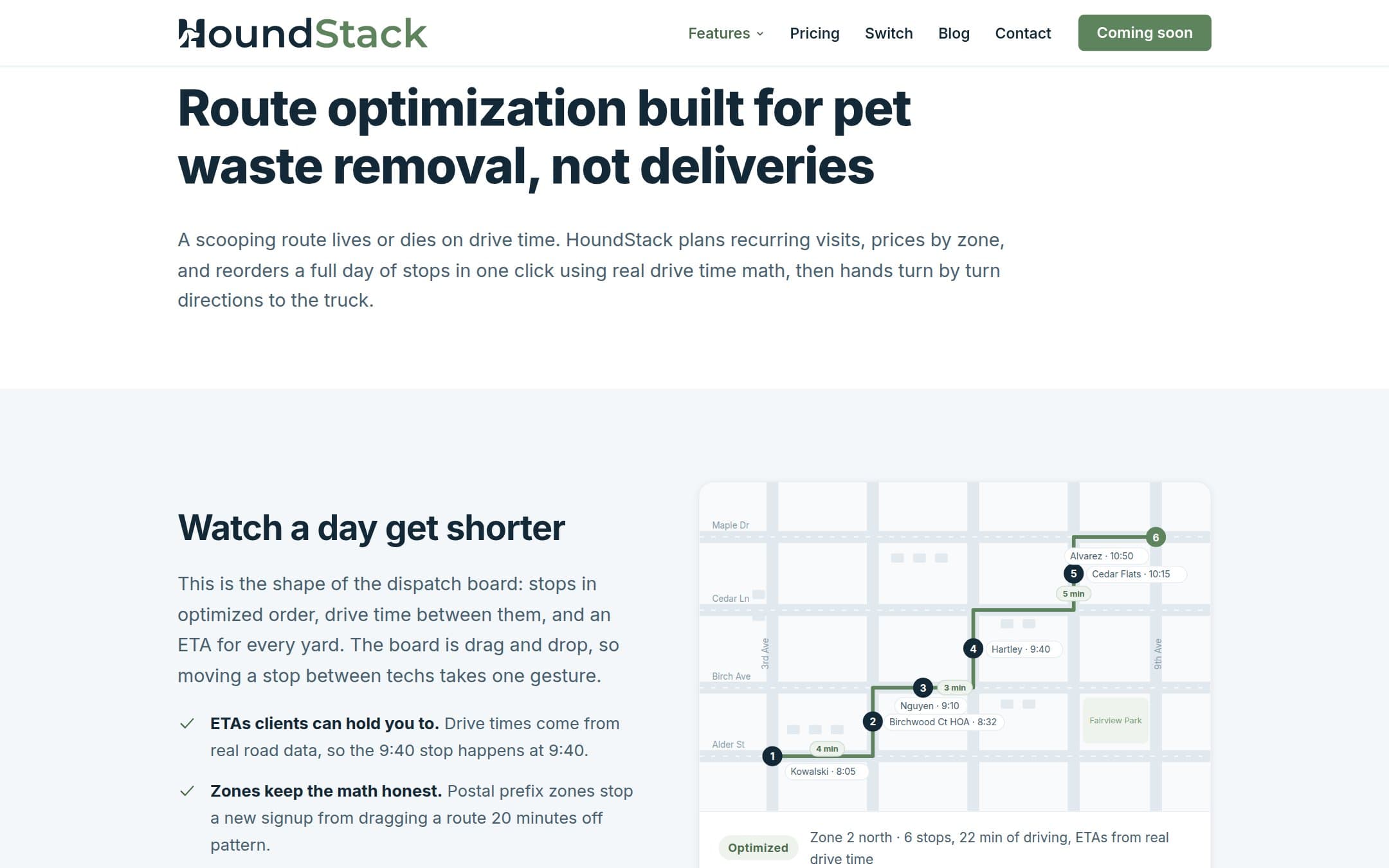
- Service zone model and route optimization requirements
- Referral, neighborhood growth, and review request mechanics
- Weather rescheduling behavior
- Role-based access across owner, office, technician, and franchise roles
- Franchise functionality requirements
- AI-assisted office workflow requirements
- Reporting requirements for operators and commercial clients
- Product documentation and QA process
Selected work
Captured from the live site.Selected visual work
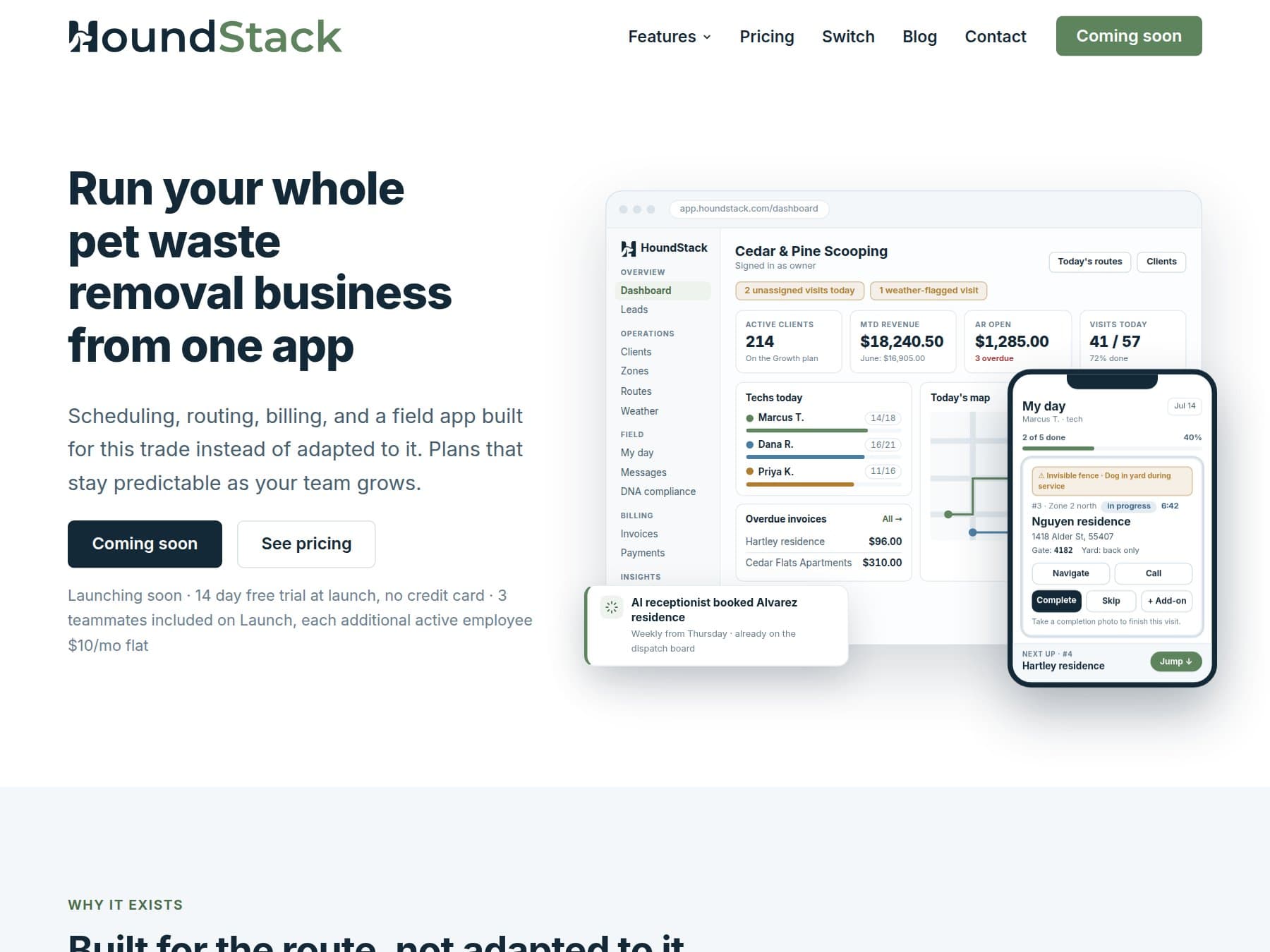
Systems
Systems and integrations
- Recurring scheduling engine
- Generates visits from frequency and service zone
- Route optimization
- Sequences daily work by zone and capacity
- Offline field workflow
- Technician completion without reliable connectivity
- Billing and payments
- Recurring billing reconciled to delivered service
- Role-based access control
- Owner, office, technician, and franchise permissions
Outcome and evidence
Numbers only where there is proof.What came of it
HoundStack is in its final stretch before launch, with a defined operational model covering customer management, scheduling, routing, dispatch, field operations, billing, commercial and HOA workflows, franchising, and reporting.
The clearest outcome of the product work is that the hard operational cases were specified before they were encountered. Weather rescheduling, mid-cycle dog count changes, HOA unit turnover, and skipped visits that should not be billed are modeled behaviors rather than support tickets.
Product scope
A defined operational model spanning scheduling, routing, dispatch, field operations, billing, commercial and HOA workflows, franchising, and reporting.
Edge-case coverage
Weather rescheduling, mid-cycle service changes, property-unit turnover, and delivery-reconciled billing were specified as first-class flows.
Held back on purpose
One further result is awaiting supporting evidence and is intentionally not published here. Numbers appear on this site only once they can be backed by a screenshot, a report, or written client confirmation.
How results are stated on this site
- Verified
- Backed by a screenshot, report, or written client confirmation. May be shown as a figure.
- Qualitative
- True and describable, but not measured. Shown as language, never as a number.
- Pending
- Claimed but unconfirmed. Never published until evidence exists.
Reflection
What I would tell you about it
The most useful thing I did on this product was spend a long time on an industry that most software people would consider unglamorous. The depth is the moat. A generic scheduler cannot represent per-dog pricing against variable frequency without the operator working around it.
The second most useful thing was insisting the technician experience be specified for the worst conditions. Every field role I have held has taught me the same lesson: the demo environment lies.
If I were starting again I would formalize the QA and regression process earlier. Catching a scheduling regression at the specification stage is cheap. Catching it after a week of generated visits is not.
Related work
Different industry, same shape
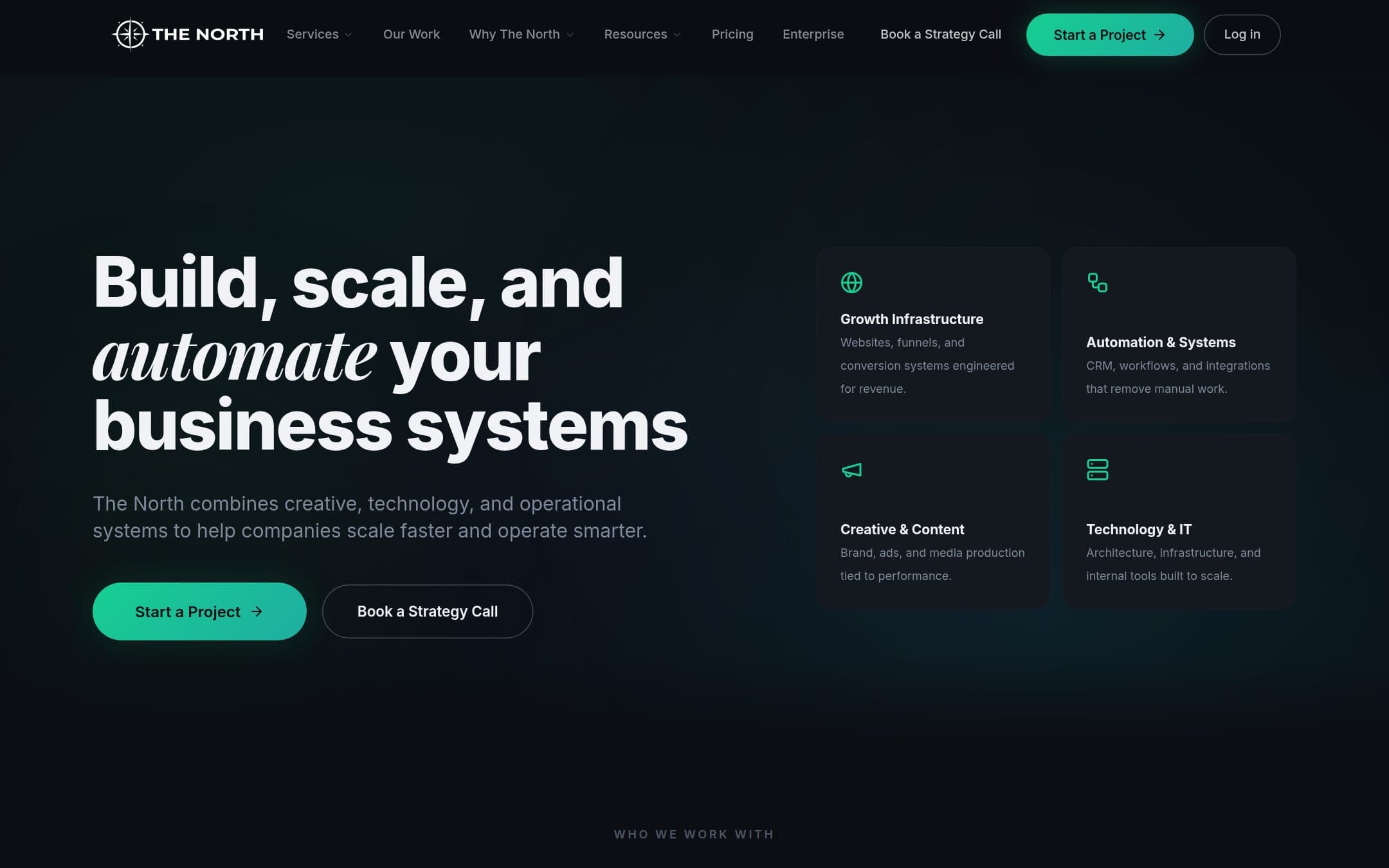
Consultancy
The North
A consultancy built on the premise that most growth problems are operational problems wearing a marketing costume.

Local field-service business
Detroit Doo Disposal
A Downriver field-service business that needed to explain itself, earn local trust, and take bookings while the owner was in someone's back yard.
Working on something like HoundStack?
If your situation rhymes with this one, the conversation is usually short and useful. Tell me where it is stuck.
Open to select opportunities
Working with me
Full-time roles, contract work, project collaboration, speaking, and introductions. This one comes straight to me.
Hiring The North
Digital strategy, business systems, customer journeys, websites, automation, and operational infrastructure. Delivered through The North.